Yinling Packaging Insights · Logistics Planning
How to Plan a Blueberry Clamshell Case Pack
A practical carton-and-pallet example for aligning retail clamshells, open-top corrugated cases, packing-house handling and freight calculations.
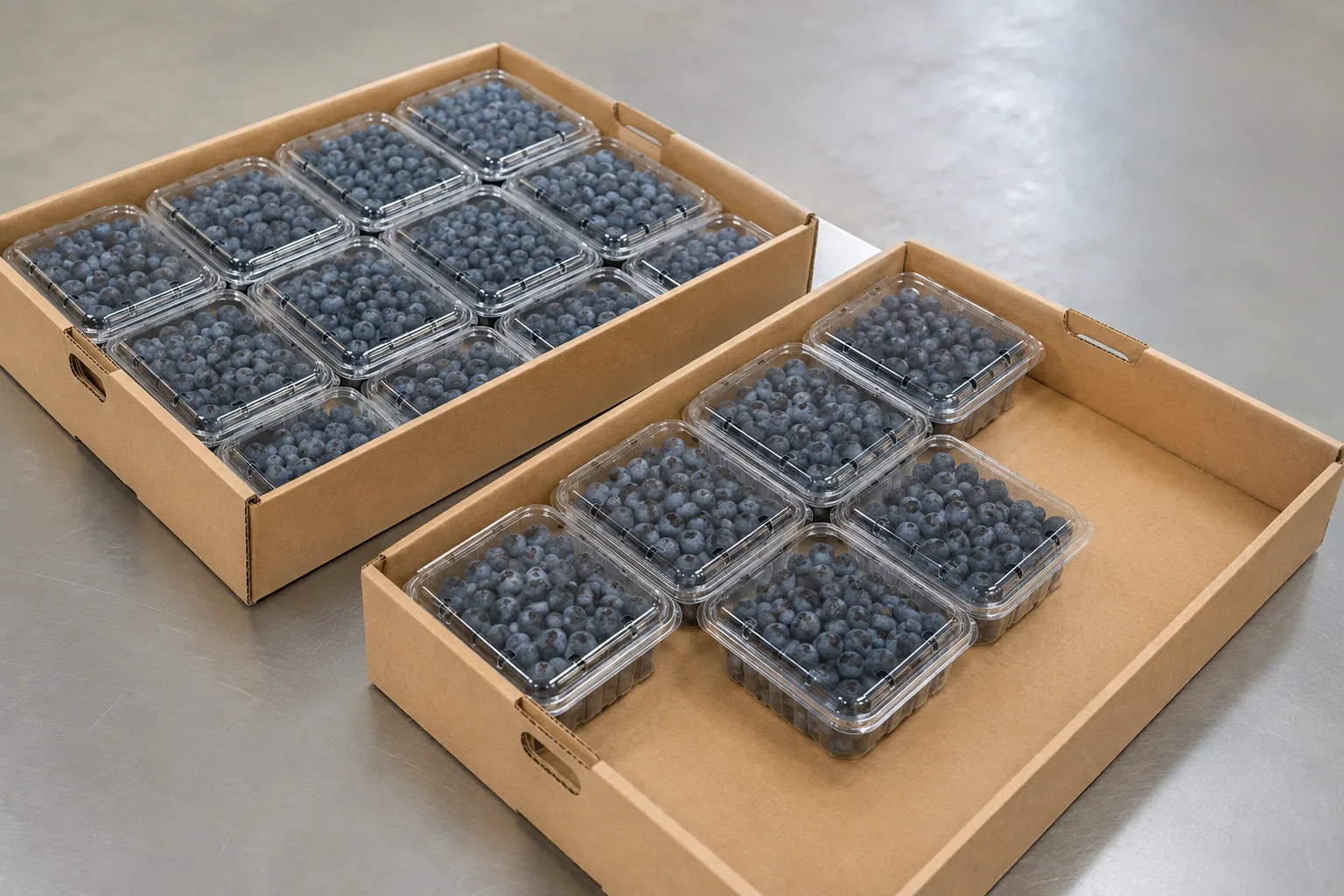
For a blueberry program, the retail clamshell and the open-top corrugated produce case have to be approved together. A small change to the clamshell flange or closed height can change the row layout, case footprint, stack pressure and pallet quantity.
This article uses a blueberry clamshell case pack as a working example. The pictured arrangement is illustrative, not a fixed Yinling carton specification. The final count must be calculated from the approved clamshell, corrugated case, pallet, cooling route and destination requirements.
Separate the four quantities in a blueberry program
“Packing quantity” may describe the empty packaging shipment or the filled blueberry load. Put the unit beside every number so the packaging supplier, packing house, produce buyer and freight forwarder are discussing the same level.
These figures are related, but they are not interchangeable. Empty PET clamshells may be nested in sleeves for delivery to the packing house. After filling, closed blueberry packs are arranged in a shallow corrugated case that supports handling, cooling and retail distribution.
Freeze the blueberry pack before sizing the case
Begin with the approved external clamshell length, width and closed height—not only a nominal blueberry weight. Record the flange, hinge and closure projections because they control the true packing footprint. Then define the internal case dimensions, wall and corner structure, hand openings, cooling openings and any head clearance needed above the lids.
Empty packs per pallet = pieces per carton × cartons per pallet
Filled retail packs per pallet = packs per produce case × cases per pallet
Keep both equations in the sourcing sheet. They answer different questions and prevent an empty-pack shipping figure from being mistaken for the grower’s finished-goods configuration.
Compare row layouts inside the corrugated case
A simple volume division assumes every space can be used. Blueberry clamshells have hinges, flanges, locking features and protective clearance. Compare aligned and rotated layouts using the final outside dimensions, then confirm that operators can load and remove every pack without catching an edge or lifting a neighboring lid.
Layout A · aligned rows
Simple counting and loading; check unused clearance beside the clamshell flanges.
Layout B · rotated packs
May use the footprint differently, but hinges, lids and hand access must remain protected.
The case should retain its designed shape when fully packed. Side walls should not press the clamshell closures inward, and upper cases should not rest directly on blueberry packs unless the complete case structure was designed and validated for that load. Check that clamshell vents and corrugated openings form a usable airflow path rather than being blocked by the layout.
Build the blueberry pallet from the packed case outward
Use the produce case’s measured outside dimensions after the blueberry clamshells are loaded. Compare the case in both orientations on the destination pallet footprint, then apply the permitted load height and weight limits supplied by the buyer, warehouse or carrier. The selected pattern must also preserve ventilation and case-edge support.
| Check | Why it changes the answer | Evidence to request |
|---|---|---|
| Carton outside size | Controls cases per layer and total cube | Packed-carton dimensions |
| Carton gross weight | May limit layers before height does | Measured packed weight |
| Pallet pattern | Orientation affects footprint use and stability | Layer diagram or trial photo |
| Maximum load height | Sets usable layers after pallet height is included | Destination or carrier requirement |
| Vent alignment | Dense loads can restrict the planned airflow path | Filled-case cooling trial |
Validate the filled blueberry case before approval
A spreadsheet is the planning stage, not the final evidence. Assemble the proposed corrugated case with the actual clamshells and representative blueberries. Confirm target pack weight and headspace, then review the case after stacking, cooling and planned handling—not only immediately after packing.
For more detail on pack weight, vents, closures and carton fit, use our PET fruit clamshell buyer’s guide. Buyers comparing rigid formats can also review the produce tray export and shipping guide. If timing is the next constraint, see what sets a custom packaging lead time.
What to send in a blueberry packaging RFQ
Send the blueberry variety and seasonal size range, target net weight, preferred clamshell or reference sample, label area, annual demand, destination, cooling route, pallet requirement and any fixed produce-case dimensions. State whether you need empty-pack logistics, filled blueberry case logistics or both.
Yinling can review standard and customized fresh-produce packaging options against the information you provide. Final carton and pallet figures should be confirmed on the selected specification rather than inferred from a similar photograph.
Prepare a comparable packaging request
Review the pack and shipping system together
Share your product, target pack weight, destination and carton constraints so the discussion starts with the right inputs.