
Yinling Packaging Insights · Development process
A custom food packaging process should move through controlled decisions: application brief, format selection, design, commercial approval, sampling, production release and first-order review. The goal is not to move quickly past each stage. It is to prevent an uncertain requirement from becoming an expensive mold, print plate or production problem.
Where the custom food packaging process begins
Start with the food and the supply chain, not with the appearance of an empty package. A useful brief explains what will be packed, the selling weight, product dimensions, filling method, storage temperature, handling route, retail display and destination market.
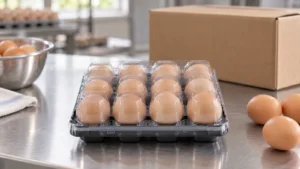
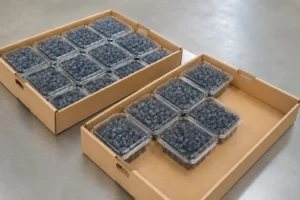
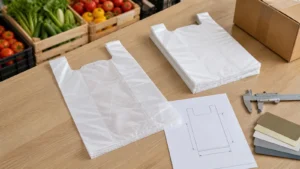
For a produce clamshell or tray, include closure, ventilation, stacking, label area, nesting and master-carton constraints. For a plastic shopping bag, include size, film specification, handle style, load expectation, printing and packing method. Forecast quantity matters because it affects the practical production and tooling route.
Six stages from packaging brief to repeatable production
Translate the application into requirements
Separate essential performance requirements from preferences. Product fit, temperature, closure or seal, packing-line use, carton arrangement and destination documentation should be identified before shape and decoration are finalized.
Review existing formats before new tooling
An existing mold or bag construction may already meet most of the requirement. Testing a standard starting point can reduce unnecessary development. New tooling becomes relevant when fit, protection, line use, carton efficiency or brand presentation cannot be solved with a current format.
Turn the brief into a manufacturable specification
Dimensions, material, structure, vents, closures, nesting, film, seals and printing must work with the manufacturing process. A buyer drawing may need a manufacturability review; a supplier proposal still needs buyer approval. Record every revision with a version number.
Confirm commercial assumptions before physical work
Clarify tooling or plate charges, ownership, sample scope, MOQ, packing, trade terms and the factors affecting lead time. Thermoformed packaging normally starts from 500 cartons; bag MOQ depends on the approved size, thickness, material, printing and packing method.
Test samples as a complete packaging system
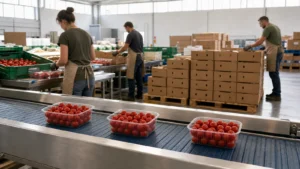
Do not approve an empty sample by appearance alone. Fill it with the actual product, apply the intended label or print, use the real packing method, build the master carton and reproduce relevant cooling, stacking and transport conditions.
Lock the production reference and review the first order
Written approval should identify the current drawing, material, sample, artwork, inspection criteria and packing instruction. After delivery, review packing-line efficiency, incoming inspection, carton performance and repeat-order changes rather than assuming development ended at shipment.
Choose the simplest viable development route
Start here when the basic structure already works
Validate the standard pack with the real product and carton. Adjust only the features that create purchasing value, and confirm whether those adjustments affect tooling, sampling or MOQ.
Use new tooling when the requirement justifies it
A new structure may be appropriate for product fit, ventilation, packing-line compatibility, carton efficiency or a dedicated retail format. Define ownership and approval responsibilities before tooling begins.
Buyers who still need to decide how design responsibility should be divided can compare OEM and ODM packaging responsibilities before starting development.
What a packaging sample should prove
Validation rule
Test the filled pack, not only the empty component
The useful question is whether the approved system works through filling, storage, transport and receiving—not whether a single sample looks attractive on a desk.
Capacity, headspace and product movement
Closure, seal, handle, vents and opening
Filling, labeling, stacking and nesting
Carton fit, compression and handling
Clarity, print, color and visible defects
Measurements, photos and approval records
Acceptance criteria should match the risk. Dimensions, weight, appearance and packing may be sufficient for one format; another may also require closure engagement, seal checks, label-position checks or agreed transport tests. The food packaging quality-control checklist explains what evidence buyers can request before shipment.
Control changes after the sample is approved
Late changes affect more than one line on a drawing. A new dimension can change nesting and carton quantity; a material change can alter forming or sealing behavior; artwork changes can affect plates and approval time. State which revision becomes effective and whether existing material or packaging can still be used.
One project should have one current approval reference. Keep the drawing, material specification, sample identification, artwork, packing method and change record together. Named approval contacts on both sides reduce delays when a revision needs a decision.
Send a brief that a packaging manufacturer can act on
Include the information that changes the recommendation
- Food or product type
- Target fill weight and dimensions
- Preferred packaging format
- Material or temperature requirements
- Closure, ventilation, seal or handle needs
- Label and printing requirements
- Packing-line method
- Master-carton and pallet constraints
- Destination market and required documents
- Forecast order and annual volume
- Target project stage or launch window
- Available drawing or physical sample
Yinling can review PET produce clamshells, food trays and printed plastic shopping bags from an existing format, drawing, sample or application brief. Explore the food packaging product range for starting formats before requesting dedicated development.
Turn the application into an approvable project
Send the product, target dimensions, use conditions, packing method, destination and forecast quantity. Yinling can review whether an existing format, modification or new tooling is the practical next step.