HDPE or LDPE? Choose the bag by the job it must do
HDPE and LDPE plastic bags can look similar on a quotation but feel and perform differently in use. Material family is only the first decision; thickness, blend, handle, seal, print and load still define the finished bag.
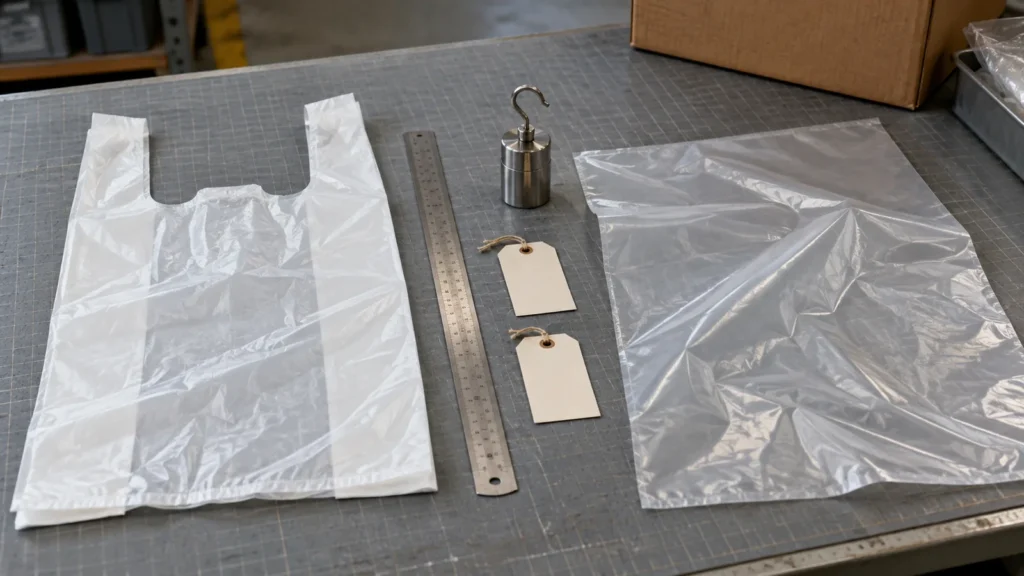
How HDPE and LDPE bags differ in practical handling
These broad characteristics help narrow the starting material. Resin grade, blend and manufacturing settings can change the final result, so use them as screening guidance rather than a universal specification.
Crisper and more structured
- Often selected for lightweight vest or T-shirt carry bags
- Typically feels stiffer and makes a more noticeable rustling sound
- Usually appears hazy or translucent rather than highly clear
- Can provide useful stiffness at a relatively light gauge
- Still requires handle, bottom-seal and carried-load testing
Softer and more flexible
- Often selected when a softer hand feel or clearer appearance matters
- Drapes more readily around irregular contents
- May suit heavier retail presentation or flat-bag formats
- Can provide a smoother visual base for some print briefs
- Still requires seal, puncture, print-rub and route testing
Compare the complete plastic bag—not resin names alone
A quotation that states only HDPE or LDPE is incomplete. The same material family can produce noticeably different bags when gauge, blend, dimensions and construction change.
| Buying factor | HDPE starting point | LDPE starting point | What to verify |
|---|---|---|---|
| Feel | Crisper and stiffer | Softer and more flexible | Approved physical sample, not a verbal description |
| Appearance | Usually hazy or translucent | Often clearer, depending on grade and gauge | Filled bag under store or packing-line lighting |
| Bag shape | Common starting point for vest/T-shirt carry bags | Common starting point for flat or heavier retail bags | Handle cut, gusset, bottom and useful internal size |
| Review ink coverage, registration and rub behavior | Review surface, opacity, registration and rub behavior | Production-representative printed proof | |
| Load | Do not infer capacity from resin alone | Do not infer durability from softness alone | Actual product mix, lift cycles and failure location |
| Cost | Affected by resin, blend, gauge, size, print, packing and order volume | Compare equivalent approved specifications | |
LLDPE and blends: a supplier may review LLDPE or a blend when flexibility, toughness or puncture behavior needs adjustment. Record the approved formulation and sample identity instead of assuming a material abbreviation guarantees performance.
Five decisions turn a resin choice into a usable bag
Keep the specification connected from the intended load through production and packing. Changing one link can change the result.
Define the load
Record item mix, total weight, edges, moisture, temperature and how the bag is carried.
Set useful size
Specify width, length, gusset, handle opening and the packed—not flat—fit.
Choose behavior
Align material family, blend, color, opacity, feel and target gauge with the job.
Build the bag
Control seals, handle cut, perforation, print area, ink system and registration.
Protect supply
Confirm piece count, inner packing, carton, labels and dispensing or line presentation.
Test HDPE and LDPE bags with the same real-world route
A fair comparison uses the same dimensions, contents, loading method and handling sequence. Otherwise the test measures several changes at once.
Opening and loading
Check how quickly the bag separates, opens and stays usable at the counter or packing station.
Handle and seal
Load the planned contents, lift repeatedly and inspect handle cuts, side areas and bottom seals.
Puncture route
Include normal corners and edges from the actual product mix; record where damage starts.
Print and appearance
Review color, registration, blocking, rub and readability on filled bags under real lighting.
Carton and dispensing
Verify piece count, folding, carton compression and how bags feed or dispense at point of use.
Destination rules
Confirm whether the market regulates bag format, thickness, recycled content, labeling or distribution.
Link material or blend, gauge, dimensions, construction, artwork, color, pack count and test result to the same code. A change in any controlled field should trigger review rather than silent substitution.
What to send a custom plastic bag manufacturer
Give every supplier the same controlled brief. This makes material, print and landed-cost comparisons more meaningful.
Include in the inquiry
- Bag format and intended use
- Flat width, length, gusset and handle dimensions
- Contents, target load and any sharp or wet items
- Preferred HDPE, LDPE or performance-based alternative
- Target gauge or approved reference sample
- Film color, clarity or opacity requirement
- Artwork, print colors, coverage and registration tolerance
- Piece count, inner packing and carton requirement
- Order quantity, destination and required delivery window
- Destination-specific regulatory and documentation requirements
Keep regulation outside the material shortcut
HDPE or LDPE does not by itself establish whether a bag is allowed in a particular market. Rules can depend on thickness, reuse criteria, recycled content, fees, markings, exemptions and distribution channel.
- Before RFQ
- Identify the destination and intended retail or produce-bag use.
- Before sample
- Translate applicable requirements into measurable specification fields.
- Before order
- Confirm current buyer and destination requirements; do not rely on a global-use claim.
Continue from material choice to production approval
Use these resources to complete the bag brief, manufacturing review and order planning.
Send the bag job, not only “HDPE” or “LDPE”
Tell Yinling the bag format, dimensions, contents, load, desired feel and appearance, artwork, packing method, destination and expected quantity. Yinling can review HDPE, LDPE and LLDPE requirements and identify a practical sample route.
Standard MOQ is generally 500 cartons. Final MOQ and timing depend on bag format, film specification, print, packing and production schedule. Early quotations are commonly discussed on an EXW or FOB basis.