
Blueberry packaging · buyer application note
The best blueberry packaging is not simply the smallest clamshell that holds the target weight. It is the format that lets berries cool, limits movement, stays closed inside the carton and presents the fruit clearly at retail.
For growers, produce packers, distributors and supermarket suppliers, that decision should be made with filled samples. Berry size, seasonal variation, cooling method and carton layout can all change how the same empty container performs.
- Confirm net weight and seasonal berry size
- Trace airflow through pack, carton and pallet
- Test closure and stacking after filling
What should blueberry packaging accomplish?
Clear PET clamshells are widely considered for fresh blueberries because they combine product visibility with a rigid outer shape and an attached lid. Those benefits only matter when the pack geometry suits the fruit and the distribution route.
01 · FIT
Hold the selling weight
Leave enough headspace to close the lid without pressing berries, but avoid excess space that encourages movement.
02 · AIRFLOW
Support the cooling route
Vent position should work with carton openings and the packhouse’s cooling method rather than being judged by hole count alone.
03 · CLOSURE
Stay shut in handling
Check the lock after filling and stacking. Product pressure and carton loads can change how the lid engages.
04 · DISPLAY
Keep fruit visible
Reserve practical space for labels and traceability information without unnecessarily covering berries or vents.
Follow the cooling path through the whole pack
Ventilation is a system decision. Openings in the clamshell cannot help if they are blocked by the label, an adjacent pack or the master carton. At the same time, more open area is not automatically better: the correct balance depends on the fruit, cooling conditions and route.
Buyers should share the precooling method, expected storage temperature and route with the supplier. The final validation still belongs in the actual packhouse process with real fruit.
Choose format by use case, not by catalog volume
Shallow format
Useful when a lower berry layer and compact retail footprint are priorities.
Check lid contact and bottom pressure.
Deeper format
Useful for larger selling weights or club-style packs when the carton is designed around it.
Check movement, visibility and stack load.
Custom format
Relevant when a fixed carton, label panel, line requirement or retail program cannot be served by an existing model.
Confirm tooling scope only after filled-pack trials.
Published container capacity is only a starting point. Variety, berry diameter and packing density affect the real net weight. Fill candidate samples with fruit from both typical and large seasonal grades before locking dimensions.
Test the clamshell inside its real carton
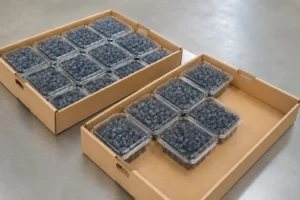
A pack may look stable on a desk and fail after layers are loaded into a master carton. A short, structured sample trial is more useful than approving an empty container from a photograph.
Fill and weigh
Use the intended net weight and record whether berries contact the lid or leave excessive headspace.
Close and reopen
Check that the lock engages consistently after filling and remains practical for retail handling.
Build the carton
Confirm pack count, orientation, divider use and whether vents remain open when units sit side by side.
Reproduce handling
Review movement, corner damage, lid collapse and pressure on the bottom layer under realistic conditions.
Inspect after cooling
Look again at closure, condensation, label adhesion and presentation before approving the specification.
How this page differs from a general clamshell guide
This page focuses on blueberry-specific pack weight, berry size and cooling decisions. For a broader comparison of PET structures, vents, closures and carton fit, use our PET fruit clamshell buyer’s guide. Buyers who already know the required format can also review Yinling blueberry container options.
Before bulk approval, connect these checks to the inspection points in our food packaging quality-control overview. A written specification should cover the accepted material, dimensions, weight tolerance, closure, visual defects, packing method and agreed sample.
Send a useful blueberry packaging RFQ
To compare suitable existing models or discuss a custom format, include the operating information that changes pack performance.
Yinling’s standard MOQ is 500 cartons. Lead time depends on model availability, customization and order details; EXW and FOB are the usual starting terms.