
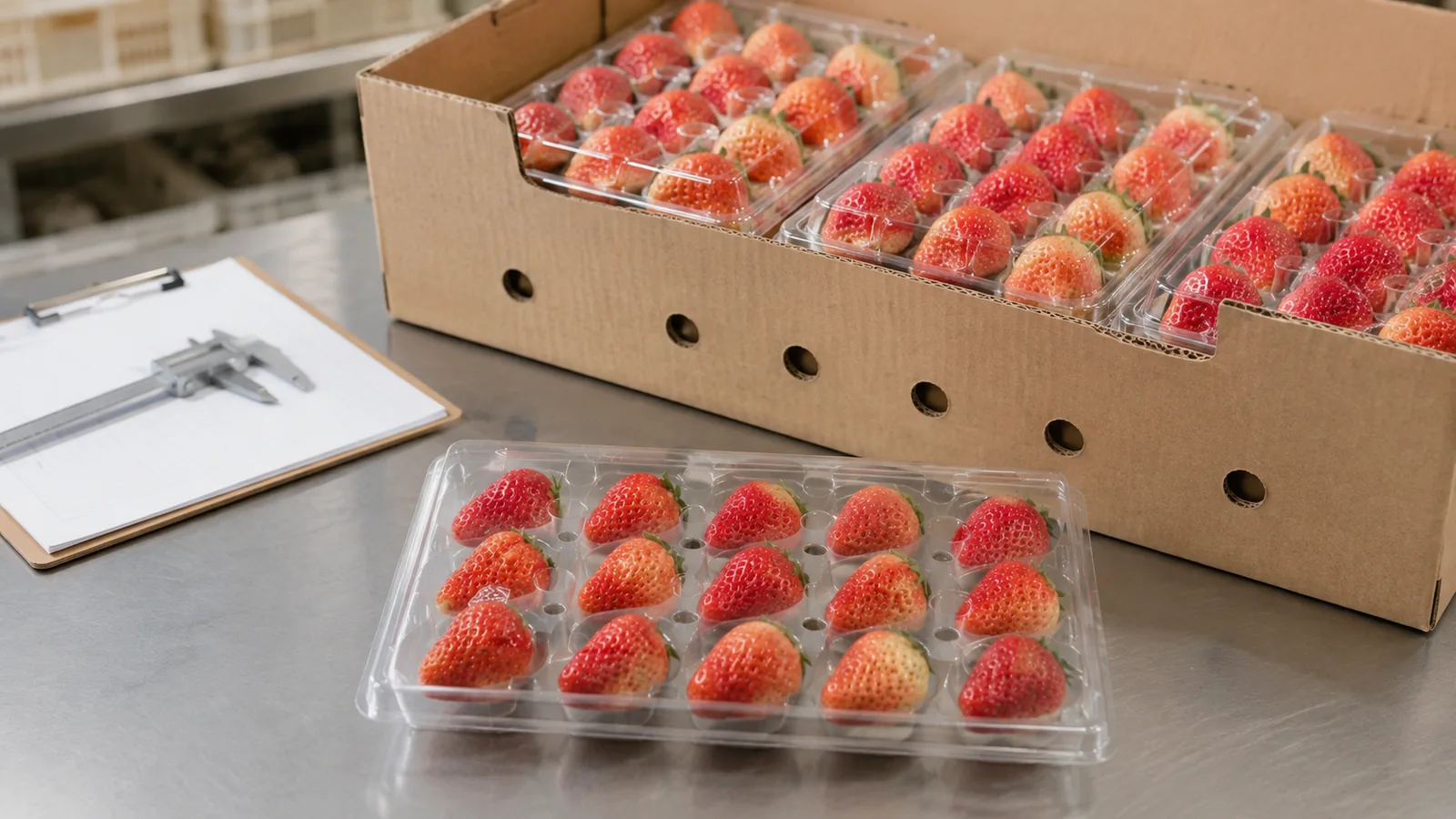
A strawberry clamshell can look correct when it is empty and still fail after packing. The risk usually comes from a mismatch between berry size, headspace, closure, vent placement, labels and the shipping carton—not from one feature viewed in isolation.
Start with the fruit range, not a nominal pack weight
Two strawberry programs can target the same net weight but need different internal space. Variety, seasonal size, calyx position and packing pattern affect how the fruit sits in the container. A pack selected only by a weight label may be too shallow for one crop and unnecessarily large for another.
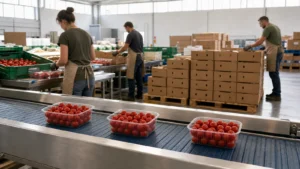
Send the supplier a practical range rather than one ideal berry. The filled trial should include the larger fruit expected in the season and the actual arrangement used on the packing line. This exposes lid contact, unstable cavities and unused space before the carton is ordered.
- Target net weight and expected count per pack
- Typical and upper-range berry dimensions
- Single-layer, cavity or loose-fill arrangement
- Label position and required visible product area
Review ventilation as one connected path
More holes do not automatically create a useful cooling path. Openings must stay aligned from the fruit and clamshell through the carton and pallet arrangement.
Test the lid after filling and repeated handling
A closure that clicks on an empty sample may behave differently when fruit reaches the lid or the pack flexes under handling. Check whether the lock engages consistently at normal packing speed, whether the hinge folds without distortion, and whether the pack stays closed when lifted from the carton.
The target is not the strongest possible lock. It is a repeatable closure that protects the product through packing and distribution while remaining practical for the intended retail use.
Use the carton to reveal movement and stacking pressure
A few millimeters across each pack can change the entire case arrangement. Too much clearance allows packs to shift; too little can make workers force packs into the carton or transmit pressure into the lids. Both conditions are difficult to judge from a container drawing alone.
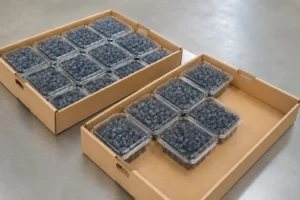
Build the intended case pack with filled samples. Review side clearance, top clearance, pack orientation, carton openings and how the upper layer transfers load. If the carton is already fixed, treat its internal dimensions as an input to the clamshell review—not as a detail to solve after sampling.
Translate what you see into the next packaging check
| Observed issue | Review first | Evidence to request |
|---|---|---|
| Top berries are marked | Berry height range, usable headspace and closing method | Side-view filled samples using upper-range fruit |
| Lids open in the carton | Lock engagement, hinge flex and pressure from adjacent packs | Filled closure checks before and after carton handling |
| Cooling is uneven | Vent alignment through labels, packs, carton and pallet | Final label mockup and complete carton arrangement |
| Packs shift or lean | Footprint, nesting features and internal carton clearance | Filled case-pack photos and measured carton interior |
One approved sample is a starting point
Berry size and firmness can change during a season. Keep the approved configuration, then repeat focused filled-pack checks when the crop, carton, label or packing method changes.
- Lock the inputs. Record fruit range, fill, clamshell reference, label and carton arrangement.
- Test the packed system. Review lid contact, closure, movement, vents and stacking with real fruit.
- Retain the approved reference. Link the physical sample to the current drawing and packing instruction.
- Recheck meaningful changes. Do not assume a new season or carton behaves like the first approval.
Send the fruit, pack and carton information together
Yinling can review standard catalog starting points or custom thermoformed PET strawberry packaging. Standard thermoformed orders generally start from 500 cartons; final MOQ and lead time depend on the approved specification, quantity, tooling needs and production schedule.
- Target weight and count
- Berry size range
- Pack arrangement
- Carton internal size
- Cooling and distribution route
- Label and destination market
Have fruit and carton measurements?
Share photos, dimensions and the expected case arrangement. Yinling can help identify which details should be confirmed before sampling and bulk production.