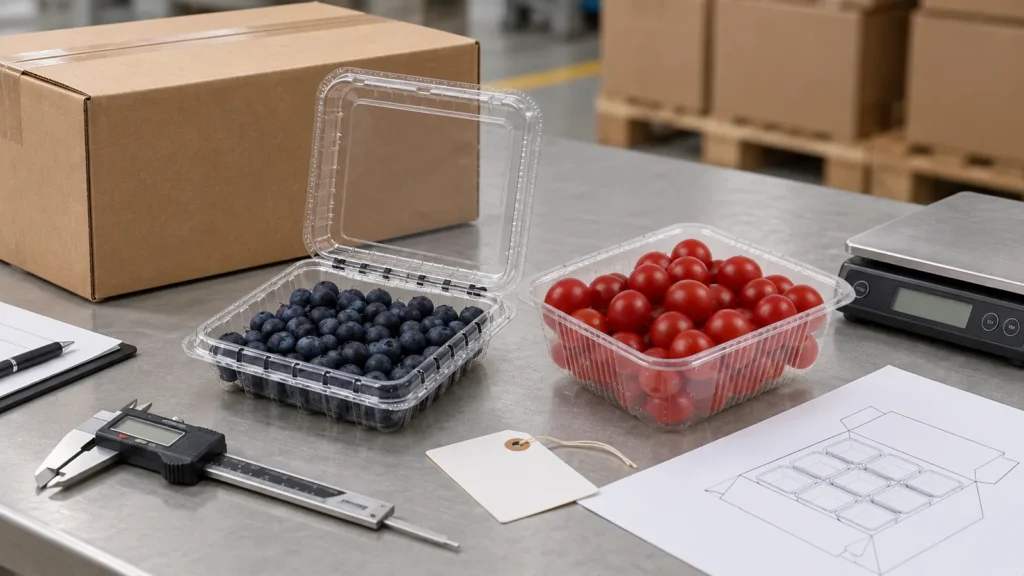
A fresh produce packaging supplier should be qualified against the packed product, the carton and the route—not by an empty sample alone.
For an exporter, the useful question is whether one specification can move cleanly from sample approval to repeat orders. Start with crop and pack data, verify the supplier’s manufacturing and inspection evidence, then approve a filled pack inside the actual shipping carton.
Give suppliers one comparable starting point
A catalogue link is not enough for a serious quotation. Two exporters can ask for a “500 g fruit box” while needing different depth, ventilation, closure, carton orientation and destination documents.
Send the same application brief to every candidate. This reduces vague alternatives and makes price, carton quantity and sample results easier to compare.
Shortlist packaging by the job it must perform
A supplier should explain why a format fits the route and where it still needs testing. The decision is not simply clear plastic versus flexible plastic.
PET clamshell
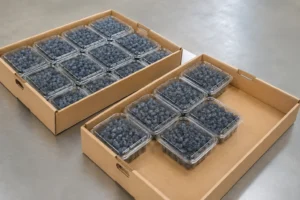
Useful when a hinged, retail-ready pack is required. Review berry height, hinge movement, latch engagement, vents and case-pack fit.
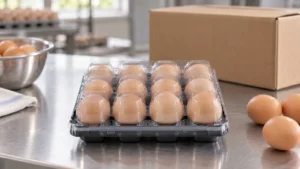
Produce tray
Useful when the product needs a supporting base before lidding, wrapping or carton packing. Review rim, depth, nesting and the selected closure.
Flexible produce bag
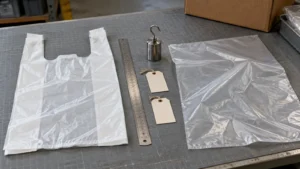
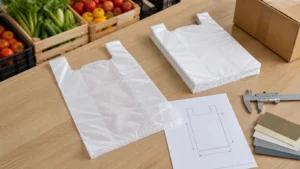
Useful for lightweight grouping and printed retail programs. Confirm dimensions, film construction, openings, print artwork and packing method.
Ask for evidence that matches the packaging route
Manufacturing evidence is useful only when it connects to the item being quoted. For a thermoformed clamshell or tray, ask how material, forming, trimming, appearance and packing are controlled. For a bag, ask how film, sealing, printing and final pack-out are checked.
Yinling reviews PET, rPET and PP rigid formats as well as HDPE, LDPE and LLDPE bag projects. The final material route, documentation and application requirements should be confirmed before an order is approved. Where a buyer requires independent checks, third-party inspection through organisations such as SGS, BV or Intertek can be discussed for the specific order.
Test filled packs inside the real carton
An empty package can look correct and still fail during packing or distribution. Approval should reproduce the intended product size, net weight, closure, case count and orientation.
Pack and close
Check loading, headspace, rim cleanliness, hinge movement, latch or lidding engagement and normal handling.
Case-pack
Confirm rows, layers, carton clearances, pack movement and whether openings remain usable in the chosen orientation.
Route review
Review cooling, storage, stacking, pallet plan and the transport conditions that the buyer will validate.
Define what must stay consistent after sampling
A repeatable supply program needs more than a signed sample. Record the controlled specification and the evidence that will accompany production and shipment.
Compare the same commercial scope
A low unit price can hide a different carton quantity, carton volume, material route, inspection scope or trade term. Compare quotations only after these fields are aligned.
| Compare | What to align | Why it matters |
|---|---|---|
| Product specification | Material, dimensions, thickness or weight, closure and print | Prevents unlike products from appearing equivalent |
| Packing | Pieces per inner pack and carton; carton dimensions | Changes storage and freight calculations |
| Order route | Existing format or new tooling; approval stages | Changes cost, risk and scheduling |
| Trade terms | EXW or FOB point and included documents | Defines where supplier cost and responsibility end |
For standard thermoformed packaging, Yinling’s usual MOQ is 500 cartons. Bag MOQ depends on size, thickness, material, print and packing. Lead time depends on the confirmed specification, tooling or artwork needs, quantity, raw materials and production schedule. EXW and FOB are the usual starting terms; other arrangements can be reviewed for suitable larger orders.
Send the packed-product brief, not only a product name
Share the crop, pack weight, preferred format, product or package dimensions, carton information, destination, forecast and target timing. Yinling can review existing-format and custom-development directions before the quotation is finalised.