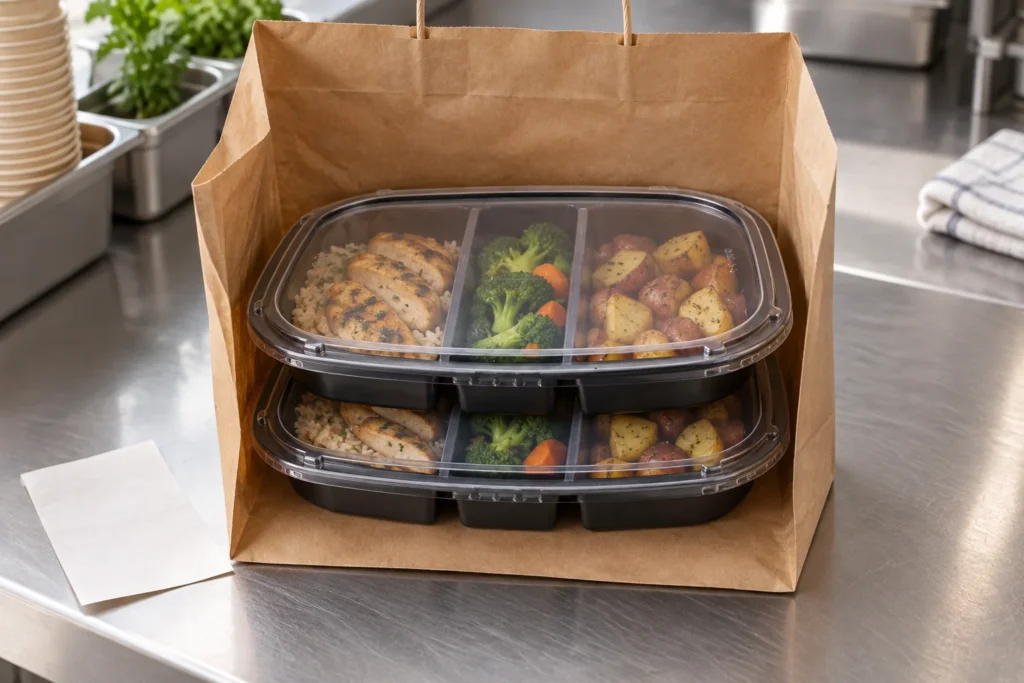
Test the meal, lid and delivery route together
There is no single “best” takeaway container. A workable choice matches the filling condition, free liquid, portion, closure and the way the packed meal will be stacked and carried.
Five questions to answer before requesting samples
Capacity alone cannot predict whether a pack will arrive clean, hold its shape or open comfortably. Give suppliers the operating conditions that the finished pack must survive.
At what condition?
Record whether the meal is packed hot, warm, ambient or chilled, plus the dwell time before closing.
What can move?
Note oil, sauce, free liquid and steam—not just the menu name.
How much space?
Define net weight, food height and lid clearance with the real portion.
How will it travel?
Describe stacking, bag orientation, delivery time and handling points.
What happens later?
State opening, reclosing or reheating needs only where the exact pack specification supports them.
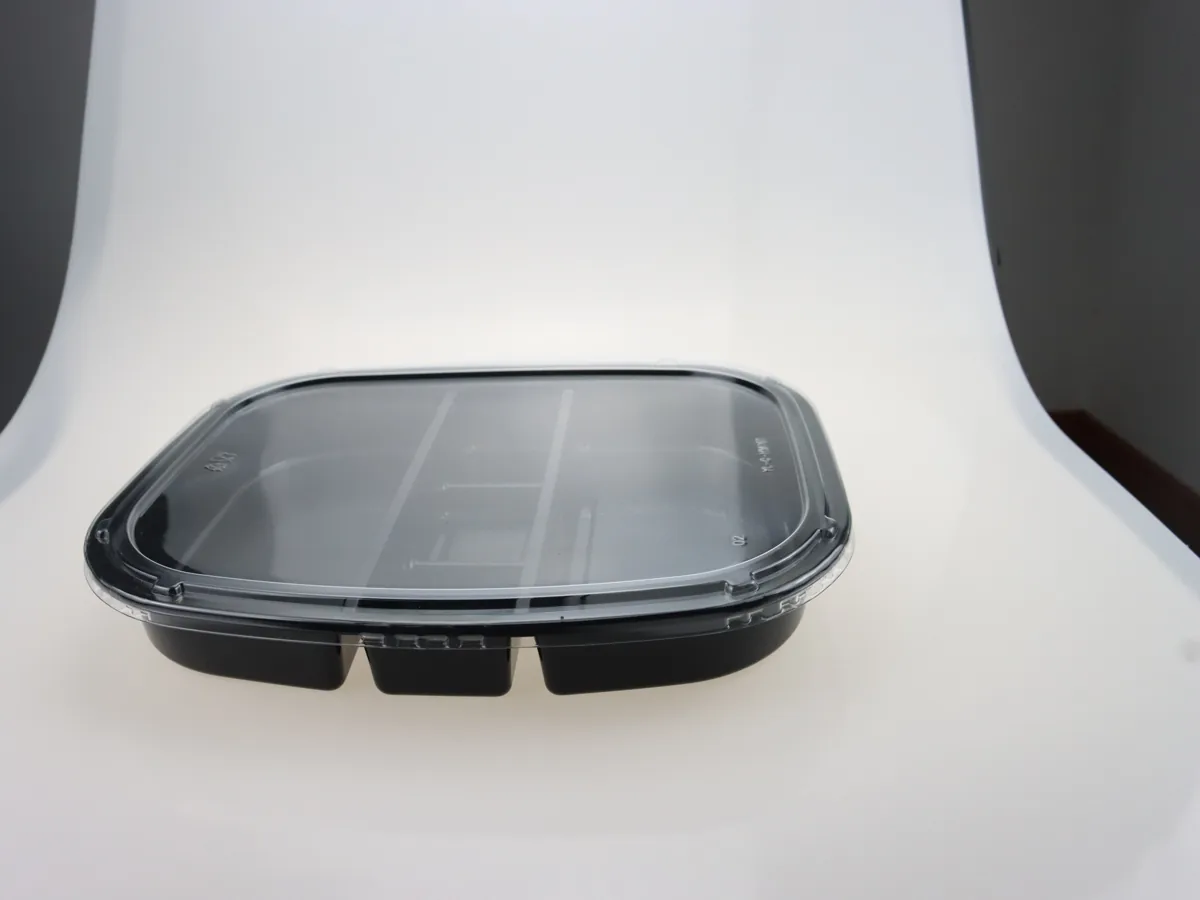
Use PET or PP to narrow the shortlist—not to approve the pack
PET is commonly considered when clear cold-display presentation leads the decision. PP is commonly considered when the application needs greater service-temperature tolerance or a more flexible response. Grade, geometry, lid design and forming conditions still affect the finished container.
Consider product visibility, condensation, closure and display handling with the actual filled sample.
Review filling condition, lid fit, stacking and consumer-use instructions for the exact base-and-lid combination.
Do not generalize from the resin code: not every PP pack is approved for microwave use, and standard thermoformed PET should not be assumed suitable for hot filling. Confirm the quoted specification and intended-use evidence.
For a fuller material screen, compare PET vs PP food containers.
Look for the failure mechanism—not a vague “leakproof” promise
The same container can behave differently after the portion, closing method and delivery route change.
Liquid at the edge
Overfill, food on the sealing surface or a mismatched lid can prevent an even closure. Inspect the full rim after packing.
Condensation and texture
Closing timing can change moisture inside the pack. Evaluate food quality at the real handover time.
Load transfer
Check whether upper packs press the lid, rim or meal below after the planned stack height is reached.
Cross-over and clearance
Confirm that portions stay within their compartments and do not interfere with lid closure during movement.
Approve with one simple operating sequence
A short, repeatable simulation is more useful than squeezing an empty container at a desk.
Use the real meal
Pack the target weight and food height at the intended filling condition.
Inspect the rim
Follow the actual closing method and check every side for complete engagement.
Build the order
Use the planned stack, delivery bag and any drinks or side items normally carried with it.
Simulate the route
Include lifting, corners, vibration, short tilts and the expected holding time.
Record arrival
Photograph leakage, deformation, compartment cross-over, condensation and opening experience.
That makes material, geometry and supplier comparisons clearer—and gives quality teams a practical receiving reference. See Yinling’s food packaging quality-control checklist.
Freeze the sample before comparing bulk quotations
Two prices are comparable only when both suppliers are quoting the same base, lid, material, packing method and approval criteria.
Include in the RFQ
- Meal type, filling condition and free-liquid risk
- Target net weight, food height and compartment split
- External dimensions and delivery-bag limits
- Base, lid, closure and any tamper-evidence requirement
- Stack count, holding time and route-test conditions
- Carton count, nesting direction and destination
- Required food-contact documents for the destination market
Standard or custom?
Start with an existing format when dimensions and route tests are acceptable. Move to customized tooling only when the meal, line or logistics requirement creates a clear gap.
For custom work, align drawings, samples and approval points through the custom food packaging process. If order economics are the constraint, review how packaging MOQ works.
Continue from selection to approval
Use these buyer resources to connect the container decision with inspection, development and ordering.
Send the meal and delivery brief—not only a capacity
Tell Yinling the meal type, filling condition, target portion, free-liquid risk, container dimensions, stack, delivery route, destination and expected quantity. We can review whether an existing food-container format is a reasonable starting point before custom development is considered.
Standard MOQ is generally 500 cartons. Timing depends on the selected product, material, tooling and approval route. Early quotations are commonly discussed on an EXW or FOB basis.