Start with the food journey—not the resin code
PET and PP can both be suitable food-packaging materials, but they solve different application problems. The finished container, lid, label and packing method must work together under the real filling, storage and transport conditions.
Where PET and PP usually fit
These are useful screening patterns, not universal performance guarantees. Grade, thickness, forming method, geometry and closure design can materially change how the finished package behaves.
Clarity-led, cold-display formats
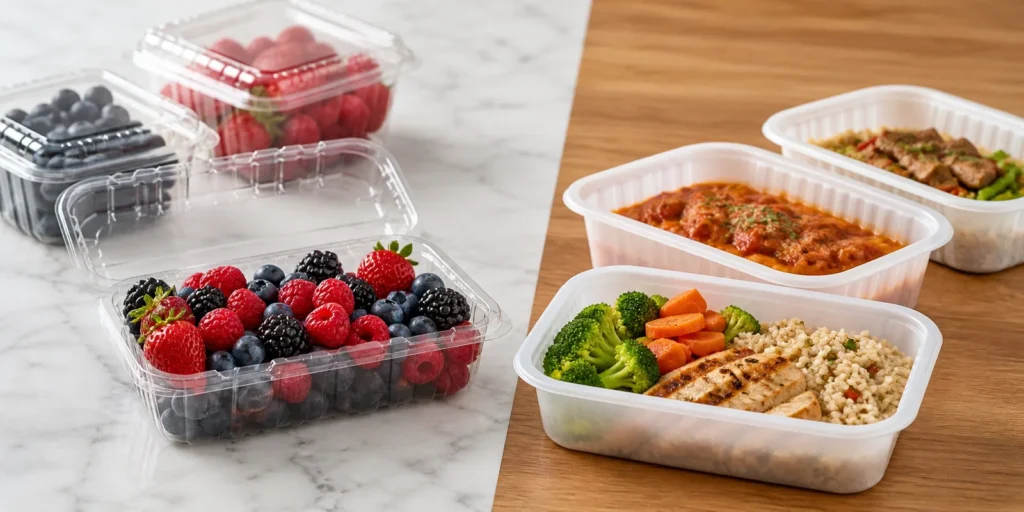
PET is widely used for clear fruit clamshells, produce containers, bakery packs and cold retail presentation where buyers and consumers need to see the product.
- High product visibility
- Stiff feel and defined shape
- Common in clear thermoformed formats
- Best assessed under actual cold-chain handling
Heat-led, flexible food formats
PP is widely used for takeaway and prepared-food containers when the application needs more heat tolerance or a less brittle response to handling.
- Common for hot-food and reheating applications
- Usually translucent or opaque rather than glass-clear
- Useful where flex and hinge behavior matter
- Final pack still requires use-condition validation
Important: “PP” does not automatically mean every container and lid is microwave suitable, and “PET” does not describe every polyester structure. Ask for the exact material, finished-pack limitations and test evidence relevant to the product being quoted.
PET vs PP food containers by purchasing criteria
The comparison becomes useful when each material property is connected to an approval decision.
| Criterion | PET | PP | Buyer check |
|---|---|---|---|
| Visual clarity | Often selected for high transparency and shelf presentation. | Commonly translucent or opaque, depending on grade and design. | View filled samples under actual retail lighting. |
| Temperature | Standard thermoformed PET is generally associated with cold or ambient applications rather than microwave reheating. | Often selected for warmer filling and reheating applications. | Confirm fill temperature, dwell time, storage and consumer-use instructions for the finished pack. |
| Rigidity and flex | Typically gives a stiffer, more display-oriented feel. | Typically provides more flex and fatigue resistance. | Test loaded stacking, drop handling, hinges and closure cycling. |
| Closure | Clear clamshell rims and latches can support visual inspection. | Flexible snap fits and separate lid systems are common. | Test the exact base-and-lid combination after filling and transport. |
| Cold handling | Performance depends on grade, geometry and target temperature. | Performance also depends on formulation and pack design. | Condition packed samples at the real temperature before impact and stack tests. |
| Recycling route | Usually identified with resin code 1. | Usually identified with resin code 5. | Verify local collection, sorting, labeling and recycled-content rules in the destination market. |
Four questions that narrow the material choice
A buyer can usually eliminate unsuitable options quickly by describing the process before discussing unit price.
What enters the pack?
Record food type, oil or moisture exposure, fill temperature, target net weight and whether the product is delicate or load-bearing.
What happens next?
Define cooling, freezing, reheating, display time, opening and reclosing. Do not assume a material code approves the use.
How will it travel?
Connect the container to the carton, stack height, pallet, route and handling points. Filled-pack testing is more useful than squeezing an empty sample.
What must the customer see?
Balance clarity, label area, color, condensation, tamper evidence and merchandising against the functional requirements.
Three common buying situations
The same food can require a different answer when the filling line or consumer-use route changes.
Cold display and product visibility
A clear PET clamshell or tray may lead the shortlist, but ventilation, headspace, closure, carton alignment and cold-chain impact still decide whether the pack works. See the produce packaging selection framework.
Hot fill or consumer reheating
A suitable PP container may be the starting point, but the base, lid, seal, label and use instructions require approval together. The takeaway packaging article connects the format to the meal.
Clarity versus operational flexibility
Both materials may remain possible. Compare presentation, closing behavior, line handling, transport and destination requirements with representative samples instead of choosing by appearance alone.
The container is only one layer of the decision
A resin comparison can become misleading when the lid, label, sealing film or carton introduces the actual failure. Freeze the complete packaging system before bulk approval.
Validate the finished package before comparing bulk quotes
Two quotations are comparable only when both suppliers are pricing the same controlled requirement.
Include in the sample brief
- Food type, fill temperature and intended use
- External and internal dimensions
- Target unit weight or agreed thickness basis
- Base, lid, hinge, latch or sealing requirement
- Filled-pack stack and transport conditions
- Label, artwork and carton configuration
- Destination-market documentation required
Release by evidence
Keep the approved sample, drawing, material declaration, packing instruction and inspection criteria connected to one revision. The food packaging quality-control checklist explains how to turn those requirements into receiving and pre-shipment checks.
For customized structures, align sampling, tooling and approval milestones through the custom packaging process before committing to a delivery date.
Connect material choice to the order
After the PET or PP route is shortlisted, use these related checks to make the quotation and approval process more precise.
Discuss the application before choosing PET or PP
Send Yinling the food type, filling and storage conditions, target pack size, carton requirement, destination and expected order quantity. We can review whether an existing PET clamshell, produce tray or another suitable format fits the project before custom development is considered.
Standard MOQ is generally 500 cartons. Timing depends on the selected product, material, tooling and approval route. Early quotations are commonly discussed on an EXW or FOB basis.